Tuesday, July 19, 2011

Chet Baker and the Mystery Box


Years ago, my friend Shila gifted me with a mysterious box which, when turned upside down and then righted again, makes a delightful pinging sound at random intervals. The mechanism is a sticky ceiling, a bunch of BB’s, and three miniature brass cymbals. When you turn it upside down, the BB’s stick on the ceiling, then release randomly, pinging on the cymbals as they fall.  I really like it.

So one day I turned it over and left it there on the floor where it attracted the immediate attention of Chet Baker, who was sure there were hoodoos or perhaps very small animals inside playing the cymbals. 

Because dogs trust their noses more than any other sense, Chet tried to smell whomever might be making music in the Mystery Box.


His trusty nose providing no information whatsoever (metal has very little smell), Chet listened and looked.


He sniffed and sniffed again. Nope, no clues. But the musical pinging kept occurring, randomly. If it had been a regular sound he'd have found it easier to ignore. 

 
Our muffled snickers notwithstanding, Chet kept at the mystery, as a bulldog will. He doesn't give up easily. Just ask the chiptymunks he corners under a big flowerpot near the Bird Spa. 
He's good for a couple of hours of waiting. He's like an Eskimo waiting for the harp seal to come up for  a breath of air.


My favorite photo of him listening. He looks like Ferdinand the Bull, sniffing flowers.

 
Finally he'd heard enough. With a thoughtful look, he turned on his heel and was done with the Mystery Box.

Sunday, July 17, 2011

Eastern Kingbird Nests


 So I'm floating along with my camera, marveling at all I've seen in a few hours of doodling around in my lil' peapod canayak. I just can't get over the array of active nests I've found. Just goes to show you what birds can accomplish when mammalian and reptilian predation is controlled by oh, four or five feet of water.

This snag intrigued me, just because the Virginia creeper framed the cavity so beautifully. I didn't see a vine running up the tree, and because it was standing in several feet of water, any vine coming from the ground would be drowned. I figured the creeper had rooted in the cavity. I circled the tree, shooting, and it wasn't until I saw the photo on the camera screen and blew it up (trying to figure out where that vine was coming from) that I saw that the tree hid another treasure.          
There was a nice nest inside the cavity, which could have belonged to a robin, but I suspected it might have been built by an eastern kingbird, because there were gobs of them around. Would a kingbird build in a cavity like that?

Well, would you?

I might.


More discoveries: I saw some stuff sticking out of the top of a rotten stub, which resolved into nesting material, and a setting kingbird. Well!


Well, hello, Missy! I'll pass by--don't you worry or get up, OK?


Luckily for you, she did leave the nest for a moment. I say that because this gives me a chance to tell you how to sex a kingbird.  See the gray wash on her breast? That's a female. Males have a clean white breast. Nice of them to have a little dimorphism, just enough to make it fun for a birdwatcher.


But my favorite kingbird nest of the day (and this was more kingbird nests than I'd seen in my life, for goodness' sake!) was the last one. I saw a beautiful kingbird fetched up on a snag, and shot a photo of it.

We bird photographers can have tunnel vision--we're trying so hard to get the bird in focus and framed that we often overlook what's around the bird. See anything interesting in this photo?


Yeah, it took me awhile, too. Sweet! There were two little heads bobbing in the nest. 


 It was a beautiful end to an incredible day on the water. All I want to do is go back to West Virginia's North Bend State Park. You can lose yourself at a place like that.


Thursday, July 14, 2011

Tree Swallows, Nesting Naturally


 Woodpeckers do a huge favor to a lot of other birds when they chisel out their cavities. Red-headed, downy, hairy and red-bellied woodpeckers are the engineers, architects and contractors for most of the house-building. Flickers also excavate, but their slightly decurved bills are not quite as well-adapted to the task, so they'll often enlarge an existing cavity or choose a punkier dead tree to make their own. The huge cavities of pileated woodpeckers are a boon to wood ducks and great crested flycatchers.

These woodpeckers are called primary cavity nesters, meaning that they make their own holes. Great crested flycatchers and tree swallows are among the secondary cavity nesters who move in when the woodpeckers move out.

There were lots of these little blue beauties swirling around North Bend State Park, choosing the lower holes nearer the water for their nests.


Definitely the most confiding of cavity-nesting birds, tree swallows wait until the very last moment to leave, and grudgingly at that. When I'm checking nests, I'm sometimes able to lift an incubating tree swallow with my finger and count her eggs, then close the box again. You have to love a bird who stares you down and lets you do that. When I find a female bird incubating in a box, I usually let them alone until the next count, but sometimes I need a base count before the eggs hatch and have no choice but to intrude.

 It was lovely to see these birds nesting where they would naturally nest, in this Brigadoon for hole-nesters, safe from predators. Tree swallows are relatively recent colonists of southern Ohio and West Virginia, having expanded their range south quite a bit over the 30 years I've been monitoring nest boxes.

When we first moved to southeast Ohio in 1992, there was one spot in the county where we could see nesting swallows--a flooded embayment of the Ohio River. Now, they're everywhere, making new cocoa-brown and white babies like this one. In my boxes--sometimes two broods a season! And here, in these dead snags. Lovely to see.


Long may they nest at North Bend!

Monday, July 11, 2011

Happy Birthday, Red Angel

Happy birthday, Red Angel. I'm going to take you back to North Dakota, because we had such fun there, and because you still had all six wisdom teeth when we were there in June. I figured you would want to see photos of yourself just as the Lord made you.


You are an excellent driver (of golf carts). Even though Al Batt doesn't look so sure, Ann and Ernie Hoffert trusted you, and so did I. I would ride in a golf cart with you anywhere. I think that's about the happiest I've seen you in a long time, tooling around in a golf cart as the sun sank in the prairie sky, throwing your head back and laughing.


I love to watch you discover nature. You field a giant puffball tossed your way without squealing and dropping it. I like that. Maybe you wouldn't eat it if I cooked it up, but you get points for catching it.


You are a creative girl, a girl happy to leave mysteries for others to decipher. If there even are any others out here.


You are kind to animals (even ones that don't match your color scheme)


and to your little brother, and he loves you endlessly for that.


You are becoming a true connoisseur of food and eating establishments both humble and grand. And you show the makings of a pretty good cook, too. You're fun to be with


and highly attractive to strangers. Strangers have the best candy.


Almost most important of all, you're hilarious, and being hilarious is a prerequisite in this family. 

Did I say you're beautiful, too? Oh, sorry. 


Happy birthday, Beautiful. The white lilacs pale beside you.


Thanks to Ann and Ernie Hoffert for the magical gift of prairie places, their glorious gardens, and their friendship. 

Friday, July 8, 2011

The Golden Turtle


Run in the rain and
You'll find the golden turtle
Treasure of treasures.

Those of you who follow me on Facebook know that for the past year I've been writing a lot of haiku. They're direct outgrowths of the process of running. I'll have been running a year on July 30. I run 7 days a week, weather and travel permitting. I'm on my third pair of running shoes. I liken the Runner's Haikus to work songs. They take my mind off the heat and humidity, off the deerflies and the weight of my body as I force it up the hills and down the hollers.


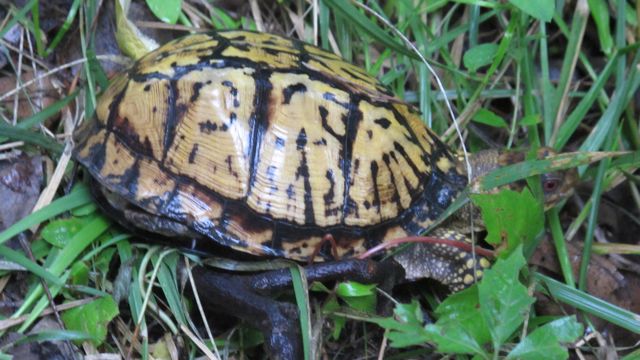
 There are rewards for the running. This morning as the rain dripped off my hat brim and soaked my shoes I found The Golden Turtle, an old female who's weathered some hardship. All the toes but one are gone from her hind feet, probably courtesy of a short-tailed shrew while she was hibernating. Shrews do worse than that; she was lucky her head and front feet were tucked in.

This calls into question her viability as a breeder. Could she dig a proper nest with soft stubs for feet, without claws? I don't know. I suppose if she found soft sand or very wet soil, she might be able to dig a nest of sorts.

Damn shrews.


I don't like to pick up or move turtles unless I have to, to get them out of harm's way.  It seems disrespectful. So these photos aren't the best, but they're the best I could get without disturbing her unduly.  In this photo you can see her eye, a dull red, hallmark of an older female. 

I left her there by our driveway, and when I came back she was gone. Soft soil and shrewless winters to you, dear Golden Turtle.


Thursday, July 7, 2011

Great Crested Flycatcher Family Photos

Watching these great-crested flycatchers going about their business made me feel a little better about my life. They never sat still, either. Even when they paused in feeding or cleaning up after their young, they were always looking for the next insect to snatch in mid-air.


 The rhythm of this old sycamore snag was so lovely, such a perfect spot for nesting flycatchers.  This is eastern North America's only cavity-nesting flycatcher, which I suppose is because it's eastern North America's only flycatcher in the genus Myiarchus. Ash-throated and brown-crested flycatchers (also Myiarchus)  nest in cavities in the West. I noted that the flycatchers had not added a trailing snakeskin to their nest. Most GCFL nests have something trailing out of the cavity.  Popular speculation holds that the flycatchers are trying to "frighten off predators" with a snakeskin, but the first one I ever found, behind my house in Richmond, VA, had a long piece of pink attic insulation trailing out of the hole! They'll use plastic, bark...a lot of different materials, leading ornithologists to conclude that they just like to have something trailing out of the hole...I was privileged to watch that nest and even see the babies, perfect miniatures of the "Wheeps!" as we called their parents, line up on a branch outside the cavity to be fed.

North Bend's lake, less than a decade flooded, offers a paradise for cavity-nesting birds in its huge stand of dead trees, protected by several feet of water. This cuts down tremendously on snake and raccoon predation, and pretty much eliminates squirrel and mouse predation. It really is a Brigadoon for cavity-nesters.


I could tell the flycatcher babies were pretty old, both by their voices and by the size and coarseness of the insects being brought to them.

 Not all the flycatchers' prey is winged. They do some gleaning, too. This might be a fishing spider, or a wolf spider. Whatever it is, it's a big 'un. 


Imagine having something that leggy stuffed into your mouth. 


With each delivery, the flycatchers took a drop-off.


Another fecal sac about to hit the water. Look at the beautiful rufous tail of the great-crested flycatcher..


More dragonfly on the way. The flycatchers followed a predictable pattern of perching, first pausing above the nest to assess the area, then dropping directly to the cavity.


 Insert insect in slot.

Pause to consider your next move. Repeat. 


The young will leave the nest at about Day 15, and be fed for about another three weeks. The literature says in general the young are flying strongly by that day. The only other option is a splashdown, and judging from the number of bass fishermen haunting the shallows, a struggling nestling wouldn't last long. I wish this beautiful family all the best. Feed 'em up!

Tuesday, July 5, 2011

Great Crested Flycatchers!

And that pewee-lookin' bird with yellow below that Phoebe found for me? Get this: Pewees have wingbars and crested heads. She had it almost zeroed in. But she had found a pair of great-crested flycatchers, and they were tending a nest!


And not just any nest, but a glorious weathered branch stub in a sycamore. And it was low, and the birds were tame, as you will see. What a find!


 The pair was busy feeding young which might have been fairly well along, to judge from the prey items they were getting. I could hear them in the cavity, voicing "wheep!" calls just like their parents'. This is something unique about flycatchers. Even as little chicks, their voices don't vary much from how their parents sound. Flycatcher calls and songs are innate, not learned. So you could take a phoebe, a pewee or a great-crested flycatcher, just to name a few, raise them in complete isolation, and they'd still have a perfect song and call from the get-go. That's not true of most songbirds.  You could have knocked me over with a feather the first time I held a newly-hatched phoebe in my palm, and it said, "Chip!" just like an adult phoebe.

So this pair of great-crests is hauling in dragonflies as fast as they can. Not the first time I've wished I'd spent more time on odonates. It pains the Science Chimp greatly not to be able to identify the great crested's prey items. Please chip in if you can.

 The birds were bombproof, eyeing me but slowing down not one whit as I fired away from just below the nest.


Input, output...they carried away sizable fecal sacs of processed dragonfly with each visit.


 The original disposable diaper: the fecal sac.

 Fecal sacs are neatly encased in a mucoid coating which, if handled gently, leaves no residue on bill (or fingers, she notes).
 The bird carries them away for hygienic purposes, and to keep predators from keying in on the nest location. Birds love to drop them over water.


More great-crested family photos anon.


ptpd

http://www.777seo.com/seo.php?username=kewut&format=ptp http://www.paid-to-promote.net/member/signup.php?r=kewut Get Paid To Promote, Get Paid To Popup, Get Paid Display Banner Get Paid To Promote, Get Paid To Popup, Get Paid Display Banner