Thursday, August 4, 2011

Feeding Sluggo


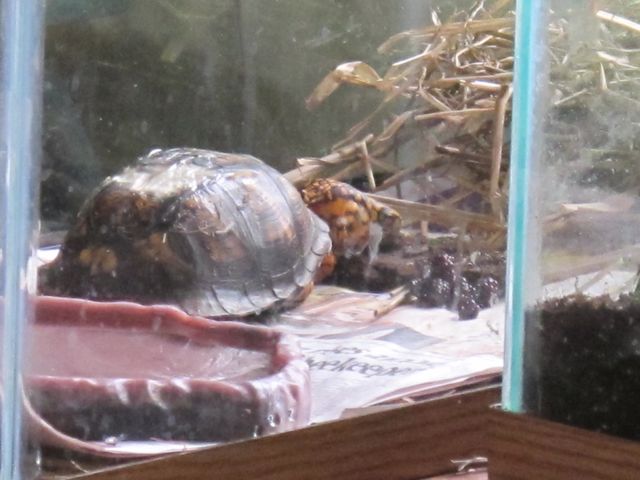
I am delighted to say that after taking his first two slugs on June 26,  Sluggo has expanded his dietary horizons from slugs to fresh cantaloupe, 
strawberries, blueberries, bananas, black raspberries, peaches and Repto-Min turtle sticks (the green things in this photo).

 I encourage him by soaking the Repto-Min in cantaloupe juice, or by pushing the dry sticks into fresh cantaloupe, where he can't help but devour them. Repto-Min is a wonderful complete food, that raises some mighty nicely shelled baby box turtles for me. Every day I put more Repto-Min in his fruit. He cleans it up!


Sluggo's housed in a 20 gallon long aquarium, with moist peat and sphagnum moss and some groovy shallow rock-like dishes just for reptiles. He's right under a south window, which gives him sun for basking. It's important to have water always available. Hurt box turtles often soak all day and night. It makes them feel better. You really have to stay on top of them, though, and keep that water clean, because they like to poopify their water. Choosing to poop in their water actually makes caring for box turtles easier, if a bit disgusting. Overall, it keeps their limited artificial environment a lot cleaner. About twice a day I'm taking sloshy poopified water outside to throw it off the deck. Ick. Worth it, though.


More than a month after finishing his injections, Sluggo's still not using his hind legs much. That's all right. They seem to work, in that he can extend and retract them. He'll get around to it eventually, and I'm not going to rush him. He's had a rough summer. And he still doesn't trust me to mess with his hinders. It takes box turtles a long time to trust someone who's once hurt them (with Baytril injections) but he'll get there. Every day he's a little more outgoing, and he'll eat from my fingers now.


 He can stay here as long as he needs to. I'll take care of him. If that means a year or two, that's fine with me. But we all look forward to the day when I can call the folks who brought him to me and tell them he's ready to come home. He'll be released right where he was found. Minus the lawnmower.


Many thanks to those who chipped in on Sluggo's treatment costs. I wasn't expecting that. Y'all paid for his Baytril, his Repto-min, his Tegaderm, his Silvodine cream and some very nice cantaloupe, and for that I thank you sincerely. You always surprise me, in the nicest ways, and fill my heart.


Tuesday, August 2, 2011

Bald Eagle Hunt!

Bald Eagle on the Missouri River, Montana

You know, I’ve been thinking about this whole dustup over hunting cranes in Tennessee and now Kentucky. And my thinking has come around 180 degrees from where it was. I get it now, I really do. I think it’s time to hunt Sandhill Cranes. And while we’re at it, I think it’s time to open a limited season on Bald Eagles. Look at the facts, lay your emotions aside and listen to reason—exactly the same reasoning that’s been so persuasive in convincing me that hunting cranes is the right thing to do.

1. We’ve always hunted Bald Eagles.
Bald Eagles were nearly exterminated from the Lower 48 by the mid 1970’s. There was a lot of hunting for Bald Eagles—it is traditionally a game species.  There was a bounty on them in Alaska from 1917 until 1952—up to $2 a head! Yes, they have been an endangered species for as long as most of us can recall, but remember, they were traditionally a hunted species. Now they’re off the red list and bouncing back into the black. The total population in the continental US has risen to around 100,000 individuals. In my home state, Bald Eagles are breeding in 35 Ohio counties. Soon, they may overrun available habitat.

2. Bald Eagles are doing well enough now to support a hunt.
Each Bald Eagle pair has the potential to produce 1.7 young per year. All regional populations have nest success >50% and are showing the productivity required to produce stable populations. So there will be an ample supply of young birds coming up for harvest.

3. Bald Eagles will provide a sporting challenge for hunters.
Bald Eagles are big and slow-flying, and they will readily come in to bait. Hunters don’t even need to use decoys. However they are wary and have famously sharp eyes, so bagging eagles will be a true sporting challenge for hunters. The Bald Eagle has the potential to be the Holy Grail of game birds.

4. Hunting eagles will not hurt, but enhance non-consumptive wildlife viewing opportunitites.
Many people like Bald Eagles—it’s almost as if they consider them sacred. These passive wildlife enthusiasts like to go places, especially in winter, to watch them. Having a hunting season on eagles won’t affect those opportunities. In fact, hunting eagles will enhance the birdwatchers’ viewing opportunities by concentrating the birds in places where they aren’t being shot at. Imagine big flocks of Bald Eagles massing on our wildlife refuges. Birder viewing opportunities will be even more spectacular.

5. We need to give hunters new opportunities and new species to hunt.
Many people similarly feel sentimental about Bald Eagles, what with their being the national symbol, but that is just an example of misplaced emotion. No bird species should be exempt from harvest. It’s our right to hunt whatever wildlife is abundant enough to support the harvest. We need to give hunters new opportunities to hunt.

6. People who protest our proposed hunt are trying to strip rights from the hunting public.
Anyone who protests this hunt is making an assault on the American way, on our right to harvest our native wildlife—a right that we have held since the first colonist fired a blunderbuss in what was to be America.

6. Bald Eagles are delicious.
Some people say Bald Eagle doesn’t taste good, but they probably have never tried it. Most people who’ve eaten eagle say it is delicious. With the right marinade, Bald Eagle is indistinguishable from a good New York strip steak. With a rapidly growing population exceeding 100,000 birds, Bald Eagle could easily become our National Dish.


So I hereby propose a season on Bald Eagles in Ohio, with the anticipation that many other states will follow suit. Let Ohio be the first to re-open a season on this traditionally hunted bird. Now that we’ve almost succeeded in pushing a Sandhill Crane hunt through in Kentucky, the sky’s the limit.

Now that I’ve got your attention, here’s the final action alert for the Kentucky Sandhill Crane hunt proposal.  I’ve already summarized some reasons NOT to hunt Sandhill Cranes in this post:

ACTION ALERT:  The USFWS has published its intention to approve Kentucky’s Sandhill Crane hunting proposal. The final deadline for comments is FRIDAY, AUGUST 5. The USFWS isn’t accepting emails, but you CAN comment online. Here’s how to do it.


Click on Submit a Comment

Type or paste  FWS-R9-MB-2011-0014-0204  into the keyword box & click Search

This will bring up the regulation page. You want "Frameworks for Early Season Migratory Bird Regulations." Buried in the text at that link is the proposal to hunt Kentucky Sandhill Cranes, along with a bunch of duck hunting stuff. It's interesting to look at it, especially the USFWS' refutation of various organizations' concerns about hunting cranes, under Section 9: Sandhill Cranes. If you want to cut to the chase and get your comment in,  click on Submit a Comment at the far right of this regulation. The idea being, despite the done-deal tone they take in the "proposal," to let the USFWS know you're out there, too.
Write your comment in the box provided (2000 characters or less)

Do it by Friday, August 5, 2011.

Snail mailed letters make an impression, especially when there are piles of them. Send your polite, well-reasoned letter to:

 Attn: FWS-R9-MB-2011-0014
Division of Policy Directives Management
U.S. Fish and Wildlife Services
4401 N. Fairfax Drive
MS 2042-PPM
Arlington, VA 22203

I sent mine today.

As always, thank you for caring and thank you for acting.  The petition to the USFWS to re-evaluate its proposal to hunt eastern sandhills now has 2,733 signatures. Go to the link above, make your comment; sign the petition if you haven't. Make your voice heard.

Sunday, July 31, 2011

Sluggo, You Have to Eat!


One of the scary things about reptiles, at least to me, is that they can go a very long time without eating. And they do. It's never good when a patient won't eat. For someone like me, who loves her charges and her babies, her friends and family with food, it's doubly upsetting.

Every day for two weeks I put tempting food right in front of that turtle. Twice a day. He'd look at it, sometimes even crane his neck, but he stolidly refused to take a bite. I tried bananas, peaches, watermelon, mealworms, earthworms, black raspberries, blueberries and slugs. Slugs are like candy to box turtles.

I went out with my headlamp, breathing the clouds of midges and gnats who were attracted to it, and hunted slugs at night. I put melon rinds out as bait and gathered them, keeping them in a little slug farm in the living room. You have one, don't you? I feed mine lettuce and spent daylily flowers.


These are Arion subfuscus, an imported European slug. Don't ask me why we have imported slugs here. We just do. Not surprisingly, they vastly outnumber our old gray slugs. 

And the turkle would look at them and let them crawl right by. Until the day when I offered two slugs on a nice piece of bark from the forest floor, which was covered with fresh earthy-smelling loam. The turtle's head shot out and he craned his neck and bam! he grabbed a slug. And then a second.


I was so excited I took these photos from across the room with my 300 mm. lens, just to document this Gandhi of turtles, digging in. He was so skittish I couldn't let him see me.

After that magic moment, no slug was safe around Sluggo. My theory is that the scent of fresh loam reminded him of home, and stimulated his appetite. 


Goo-byeeeee!

I was one relieved turtle nurse when Sluggo finally lived up to his name.


Thursday, July 28, 2011

Meet Sluggo


I have kind of an unusual Ohio wildlife rehabilitator's permit. It's for songbirds, bats and reptiles, specifically box turtles. Boxies get on the wrong end of our machines more often than I'd like to see. Cars, well, they usually don't survive an argument with a wheel. Lawnmowers are bad, too. Turtles' shells often save them, but lawnmowers can inflict some truly grievous injuries.

This handsome older gentleman came to me in late June 2011 from a wooded yard in Athens, Ohio, where the caller had accidentally hit him with a rider mower. I hate getting turtle calls because it's so hard to gauge how badly hurt the animal is from a verbal description. Is he bright? Crawling? How big is the wound? Where is it? Any limbs missing? That kind of thing. I still shudder when I remember the female boxy a couple of sweet young hippies brought me. They were very vague on the phone. Her shell was in pieces, apparently. "Yes, all the pieces are there." What they neglected to tell me, because they wanted so badly for me to somehow wave my wand and magically fix this hurt animal, was that the pieces were no longer connected to the turtle. They were rattling around in the shoebox with her. 


I could instantly see that this turtle had a better prognosis. Hey, he had a prognosis. What you're seeing here is not exposed flesh but pink shell bone, crushed and compressed, with the colored scutes knocked off. Oh, it had to hurt. The callers had done just the right thing--cleaned him up with some disinfectant and put Band-aids over the wound until they could bring him to Marietta. I took the Band-aids off and soaked a paper towel in Betadine, and let him crawl around  while the disinfectant soaked the grass and dirt loose.


Part of the protocol for turtles with bad shell wounds is eight days of Baytril (antibiotic) injections, at about $10 a day. Ouch for turtle and rehabber. These are administered in the back legs, one every other day, with a very fine needle. Still, it hurts, and the turtle purely hates it. This is the second boxy I've had who learned within a day to keep his hinders tucked and to crawl away from me using only his front legs.  That's what he's doing in the photo above--booking with his hind legs tucked.


I picked all the grass and dirt off, washed him, disinfected him again, and let him dry. I couldn't even budge the smashed-in shell pieces so I decided to let them heal as they were. He still had control over his back legs, though they and his tail were quite bruised, and I thought I could probably do more harm than good by messing about with the shell. 

Time for some spackle.


The white Crisco-like substance is Silvodine cream, an antibiotic cream for burns and deep wounds. I packed the wound with cream and got some Tegaderm, which is a surgical membrane that acts a bit like skin. Silvodine, unfortunately, needs a prescription, but Chet's veterinarian, Dr. Lutz, was happy to help with that and the Baytril, too.

Peeling off the white backing and laying the clear Tegaderm over the cream. It's adhesive.


Smoothing the Tegaderm.


Better. Not all better, but on the road to recovery without risk of infection.


Next: Sluggo, you HAVE to eat something.


Tuesday, July 26, 2011

Berry Greedy Pickers

 I can tell you that $41 worth of blueberries will just about break your arm. So we bring auxiliary containers  (plastic buckets) to dump the booty into so we can keep picking with our light little Easter baskets.


I wanted a shot of Liam walking his berries up to the garage to be counted.  But I had to stop in the middle of shooting. "Don't swing a full basket, Liam!"

"Okay!"


  And here goes Phoebe with hers.

 Not until I got this shot on the screen did I notice I'd captured a priceless moment in Liam's sweet life. Craack! Whump! Dump!


Classic! Look at his mouth, wide open. Ohhh! Dang!


Phoebe, of course, stopped to help him recover his fruit.


There was a little fellow at the cash register who was only too happy to ring us up. His mom had a terrible time keeping those fingers at bay. He wanted to punch all the keys at once, and he came at that little adding machine like a baby octopus. "I try! I try!" And she let him punch in our sale.


 Needless to say the Thomas the Tank Engine PJ's, worn all day long, endeared him to me forever. Not to mention his passionate desire to help his mom. I remembered Liam always punching keys on the credit card machine at the grocery store. He'd get so frustrated when nothing happened. His momma's a cash type.


 Too soon, it was time to turn for home. We could have picked until nightfall, but I was out of money. And truth to tell, I made a cobbler with the last of the frozen berries from June 2010 to make room for 2011 fruit in the freezer!  That's what happens when you have helpful kids (one of whom once wore his Thomas pajamas all day long, too)


and beautiful blueberries, with the greenywhite promise of more to come. Ahh, Summer. Could you just linger awhile longer, spread out your gifts through the long dull winter?


Sunday, July 24, 2011

21st Century Hunter-Gatherers

 I believe I was a crazy good hunter-gatherer in another life. I love to pick things and I'm fast at it. My kids have inherited the gene, although they tend to look for the premium fruit rather than mass volumes of it. They pride themselves not on having the most berries, but the biggest and fattest.  I pick three times faster than they do, but their berries are Super Premium.

The blueberries at Rolling Ridge Berry Farm are more the size of grapes this year. 


And they are sooo beautiful. I love the ones with the heavy bloom, like these:

They remind me of the powdery sheen on a pigeon's feather. 

All around us the songs of Baltimore orioles, scarlet tanagers, robins, cedar waxwings and yellow-breasted chats rang out from the woods and blueberry rows. You won't see crop netting here, or hear cannons or nasty recordings of starling distress calls. The Winders grow enough for the birds and us.

View from the backmost berry row, where I like to pick and bird at the same time. It's alive with yellowthroats, white-eyed vireos, chats, robins and the like.
The habitat all around is rich and birdy to start with and then this farm sets a smorgasbird. You can imagine. Lots of parent birds bring their fledglings to the farm to fatten them up and get a break from the babies' incessant demands for food.

Phoebe and Liam noticed that the sweetest berries were most likely to have a couple pierced by the triangular pecks of birds. They know where the best ones are.

So seduced were we by the abundance and ease of picking that before we knew it we had FORTY-ONE BUCKS WORTH OF BLUEBERRIES. Yiiikes. Which would have been well over $100 worth in the grocery store, only not even a tenth as fresh and delicious. To those of you who are wondering what you do with that many blueberries, we gorge on them fresh and freeze what we can't eat. We give them to friends and family, make cobblers and throw blueberries into smoothies and yogurt and over cereal. We have a blueberry ball. I'm thankful for Rolling Ridge Berry Farm. A visit there is the perfect way to spend a summer afternoon with the kids.


Thursday, July 21, 2011

LIttle Towns, Narrow Roads and Old Houses


People who visit us for the first time often comment that we live in the middle of nowhere. No, we don't, but you can see nowhere from here. And that's exactly how we like it. Every single day I thank my lucky stars that I get to live in the middle of nowhere.

Sometimes there's a day when the sky's intensity matches the land's, and somehow my Canon G-11 is able to capture the vivid blue of the sky and the shapes of the clouds without making the landforms too dark. This was such a day. A perfect summer day.  I was so happy that my photos were coming out as beautifully as the day was.
 As you can see, Bethel Twp Rd. 340 is not much more than a little driveway. That's how I like my roads. Doesn't this make you want to snoop around, see what's up there? Or more importantly, what's not up there? I've been doing that lately, taking country roads that have heretofore only been names or numbers to me. And I am never disappointed. Sometimes there's a sandhill crane or a fox or a bobcat waiting for me down these roads.

Lucky to live here, that's all.

The hamlet of Lebanon. There are several Lebanon, Ohios. This happens to be my Lebanon Ohio. It's probably the littlest one. That's how I like my towns, too.


 I think this old house is still being lived in, though I'm not sure. Maybe it's just storage. But it's untouched from how it would have looked fifty years ago. I like my old houses like that.

 It has a little shed friend. Oh how I would love to have a shed like this, a place to store the lawnchairs and bicycles. I've asked for one for my birthday. It will be a new one, but we will love it no less.

From the back porch of the old house, this is the view:


 Yucca and lilac: the two steadfast friends of little old buildings, keeping them company through the decades.

And across the road stands another shed, with a beautiful old water pump. Looking at it took me right back to the breathless anticipation of pumping my grandma Ruigh's creaky old pump, waiting and waiting for the rush of cool, iron-tinged water to come gushing into my tin cup. I didn't much like the taste of the water, but I loved that I could bring it up all by myself if I worked hard enough.


The sky was moody and blue, but our spirits were undampened. Speaking of breathless anticipation, all these vistas were ours on the way to Rolling Ridge Berry Farm, our favorite you-pick establishment of all time.


On the other side of this field lay Berry Valhalla.

ptpd

http://www.777seo.com/seo.php?username=kewut&format=ptp http://www.paid-to-promote.net/member/signup.php?r=kewut Get Paid To Promote, Get Paid To Popup, Get Paid Display Banner Get Paid To Promote, Get Paid To Popup, Get Paid Display Banner